Most founders are not building unicorns, even if they say they are
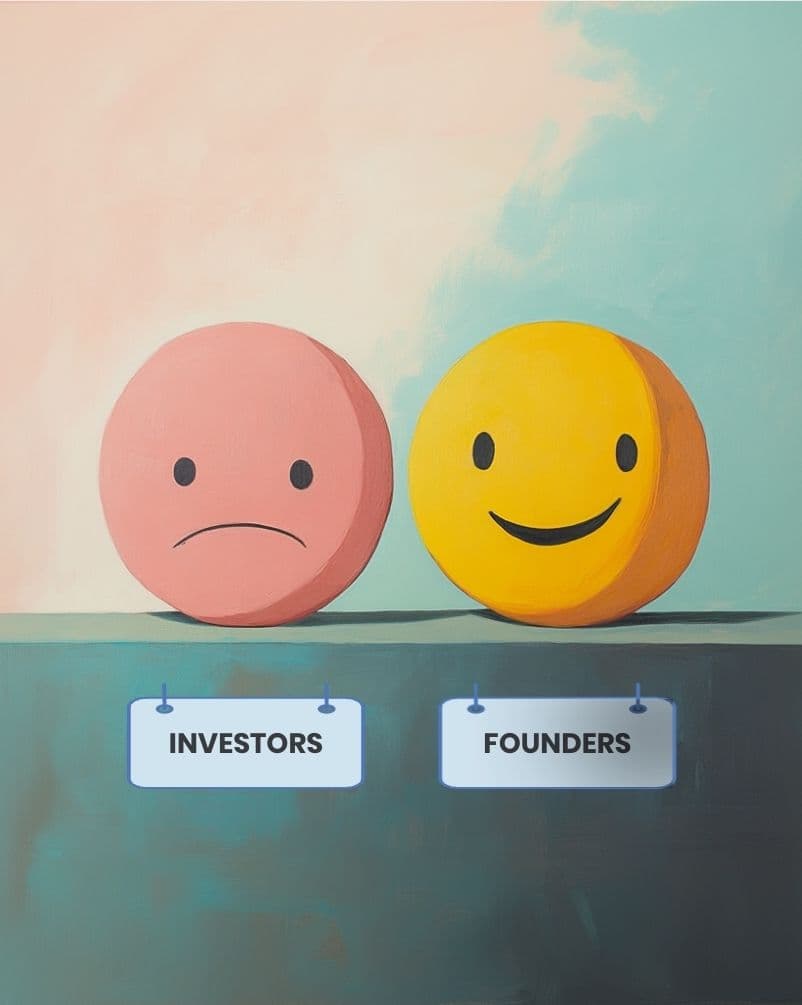
Founders are lying to their investors, but there’s an alternative.
(I’ve learned this by investing $2m into 100 companies since 2012).
If they could be honest with you, most founders would admit they’re not building a unicorn.
Even if they had a chance, they’d exit long before they got there.
In fact, I truly believe that—outside silicon Valley—most first-time entrepreneurs would be satisfied owning their own company, choosing how they work every day, and having the chance, after a few years, of selling out for several million dollars.
[Several can have different meanings for different people, by the way.]
The truth is, for most founders, a $15m exit would be life-changing.
But…
…Nobody wants to invest in that.
So founders find themselves painting a picture of global domination, despite knowing, deep down, that this is not their true vision.
Of course, some investors get onboard.
(Founders can be great salespeople.)
Unsuspecting angels will believe the hype. They’ll invest their children’s inheritances into early-stage companies valued in millions of dollars, despite the founder knowing (albeit perhaps shrouded in denial) that there’s virtually no way these investors will make a good return.
99 times out of 100 these are horrible deals for angels.
This is not a sustainable way to build companies.
Even if the founder ends up selling the company for $10m after, say, 5 years (which would be a decent result for most angel-backed founders)… for the investors it’s a failure.
Is that really what you want as an entrepreneur?
And the long-term effect?
Those investors stop doing early-stage deals.
And future founders don’t get funded.
So what’s the answer?
Well, at DQ, we think there’s a more common-sense approach to building a company.
First, instead of de-risking the startup journey with someone else’s money, we believe in de-risking it yourself with a process. Our founders don’t raise capital (or quit their job) until after they’ve validated their startup idea themselves. (We provide a process for this, then helping them create a “minimum viable business” with paying customers.)
Second, if and when they do raise money, they do so transparently. They set a reasonable timeframe, realistic exit expectations and a sensible valuation, giving everyone a chance to make money. Invariably, they raise less money than those going the venture route, in a shorter space of time, then run leaner. (We believe in growing slowly but surely, rather than boom or bust).
If you’re the kind of investor who likes the sound of that, drop me a line and I’ll make sure you receive our deal flow (3 or 4 deals per year, currently).
If you’re thinking about raising money for your startup idea, I’d love to have a chat. Maybe there’s a better way.